mirror of
https://github.com/jlengrand/bugsink.git
synced 2026-03-10 08:01:17 +00:00
 e45c61d6f0
I originally thought `SET_NULL` would be a good way to "do stuff later", but
that's only so the degree that [1] updates are cheaper than deletes and [2]
2nd-order effects (further deletes in the dep-tree) are avoided.

Now that we have explicit Issue-deletion (deps-first, delayed, properly batched)
the SET_NULL behavior is always a no-op (but with cost in queries).

As a result, in the test for issue deletion (which has deletes for many
of the altered models), the following 8 queries are no longer done:

```
SELECT "issues_grouping"."id", [..many fields..] FROM "issues_grouping" WHERE "issues_grouping"."id" IN (1)
UPDATE "events_event" SET "grouping_id" = NULL WHERE "events_event"."grouping_id" IN (1)

[.. a few moments later..]

SELECT "issues_issue"."id", [..many fields..] FROM "issues_issue" WHERE "issues_issue"."id" = 'uuid'
UPDATE "issues_grouping" SET "issue_id" = NULL WHERE "issues_grouping"."issue_id" IN ('uuid')
UPDATE "issues_turningpoint" SET "issue_id" = NULL WHERE "issues_turningpoint"."issue_id" IN ('uuid')
UPDATE "events_event" SET "issue_id" = NULL WHERE "events_event"."issue_id" IN ('uuid')
UPDATE "tags_eventtag" SET "issue_id" = NULL WHERE "tags_eventtag"."issue_id" IN ('uuid')
UPDATE "tags_issuetag" SET "issue_id" = NULL WHERE "tags_issuetag"."issue_id" IN ('uuid')
```

(breaks the tests b/c of constraints and not always using factories; will fix next)
Bugsink: Self-hosted Error Tracking
Bugsink offers Error Tracking for your applications with full control through self-hosting.
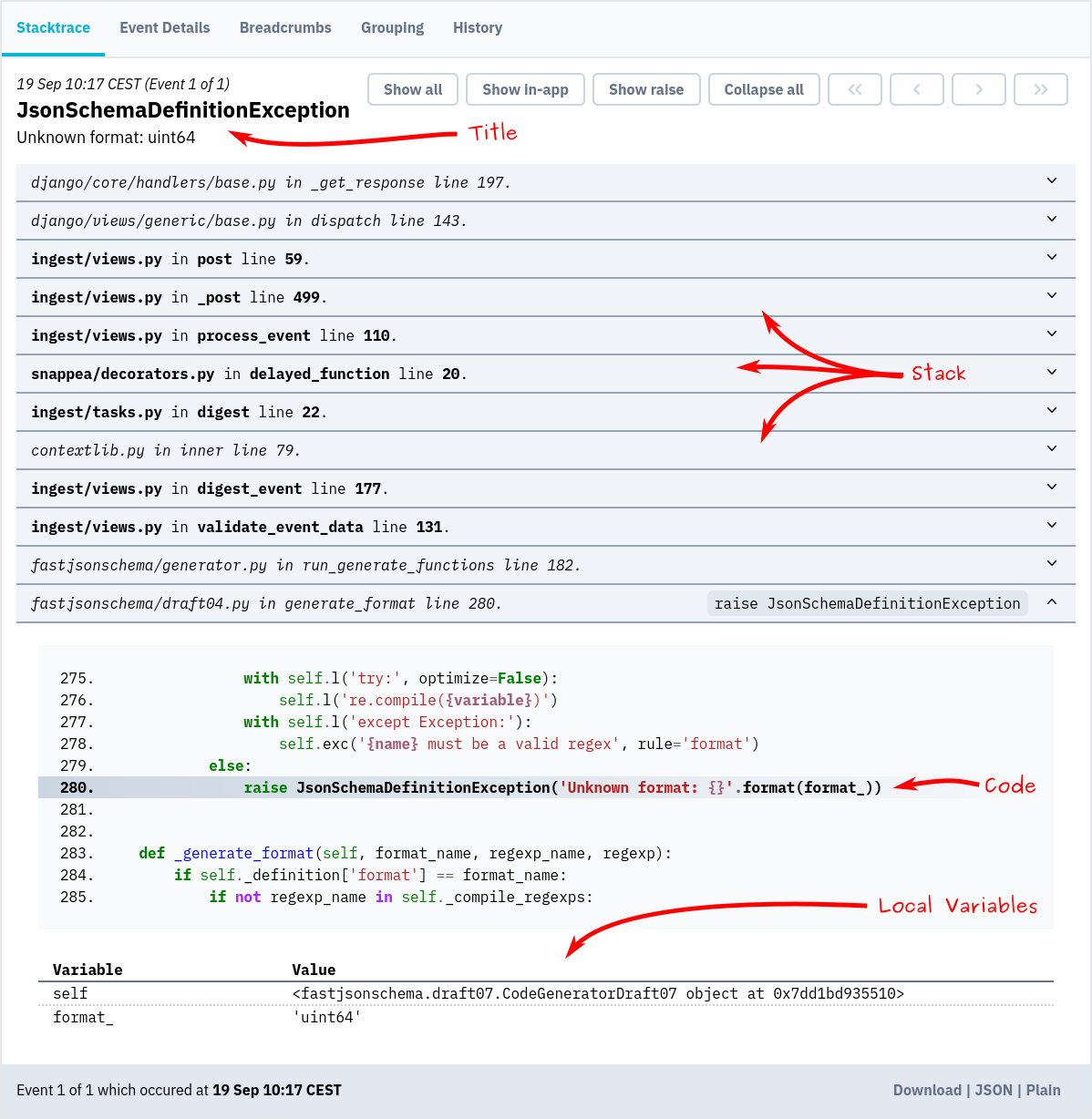
Screenshot
This is what you'll get:
Installation & docs
The quickest way to evaluate Bugsink is to spin up a throw-away instance using Docker:
docker pull bugsink/bugsink:latest

docker run \
  -e SECRET_KEY={{ random_secret }} \
  -e CREATE_SUPERUSER=admin:admin \
  -e PORT=8000 \
  -p 8000:8000 \
  bugsink/bugsink
Visit http://localhost:8000/, where you'll see a login screen. The default username and password
are admin.
Now, you can set up your first project and start tracking errors.
Detailed installation instructions are on the Bugsink website.