mirror of
https://github.com/jlengrand/bugsink.git
synced 2026-03-10 08:01:17 +00:00
 cd7f3978cf
* denormalize IssueTag.key; this allows for key to be used in and index
  (issue, key, count).

* rewrite to grouping-first, per-key-query-second. i.e. reverts part of
  bbfee84c6a. Reasoning: I don't want to rely on "mostly unique" always
  guessing correctly, and we don't dynamically determine that yet. Which
  means that (in the single query version) if you'd have a per-event value for
  some tag, you could end up iterating over as many values as there are events,
  which won't work.

* in tags.py, do the tab-check first to avoid doing the tag-calculation twice.

* further denormalation (of key__key, of value__str) actually turns out to not
  be required for both the grouping and indivdual queries to be fast.

Performance tests, as always, against sqlite3.

--

Roads not taken/background

* This commit removes a future TODO that "A point _could_ be made for
  ['issue', '?value?' 'count']", I tried both versions of that index
  (against the group-then-query version, the only one which I trust)
  but without denormalization of key, I could not get it to be fast.

* I thought about a hybrid approach (for those keys with low counts of values
  do the single-query thing) but as it stands the extra complexity isn't worth
  it.

---
on the 1.2M events, 3 (user defined) tags / event test env this
basically lowers the time from "seconds" to "miliseconds".
Bugsink: Self-hosted Error Tracking
Bugsink offers real-time error tracking for your applications with full control through self-hosting.
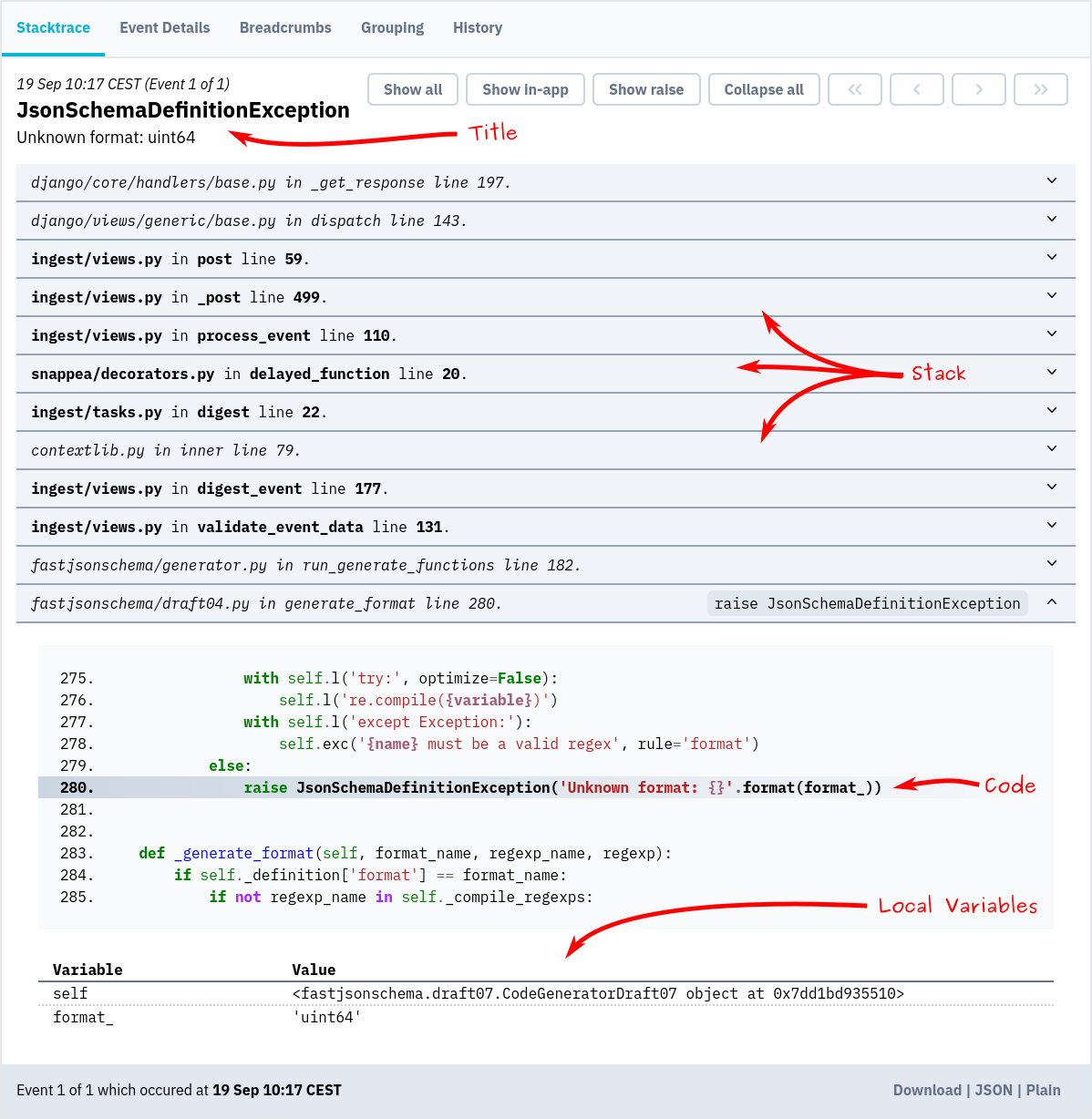
Screenshot
This is what you'll get:
Installation & docs
The quickest way to evaluate Bugsink is to spin up a throw-away instance using Docker:
docker pull bugsink/bugsink:latest

docker run \
  -e SECRET_KEY={{ random_secret }} \
  -e CREATE_SUPERUSER=admin:admin \
  -e PORT=8000 \
  -p 8000:8000 \
  bugsink/bugsink
Visit http://localhost:8000/, where you'll see a login screen. The default username and password
are admin.
Now, you can set up your first project and start tracking errors.
Detailed installation instructions are on the Bugsink website.