mirror of
https://github.com/jlengrand/bugsink.git
synced 2026-03-10 08:01:17 +00:00
 1eea9268a5
When searching by tag, there is no need to join with Event; especially when
just counting results or determining first/last digest_order (for navigation).

(For the above "no need" to be actually true, digest_order was denormalized
into EventTag).

The above is implemented in `search_events_optimized`.

Further improvements:

* the bounds of `digest_order` are fetched only once; for first/last this info
  is reused.

* explicitly pass `event_qs_count` to the templates

* non-event pages used to calculate a "last event" to generate a tab with a
  correct event.id; since we simply have the "last" idiom, better use that.
  this also makes clear the "none" idiom was never needed, we remove it again.

Results:

Locally (60K event DB, 30K events on largest issue) my testbatch now
runs in 25% of time (overall).

* The effect on the AND-ing are in fact very large (13% runtime remaining)
* The event details page is not noticably improved.
Bugsink: Self-hosted Error Tracking
Bugsink offers real-time error tracking for your applications with full control through self-hosting.
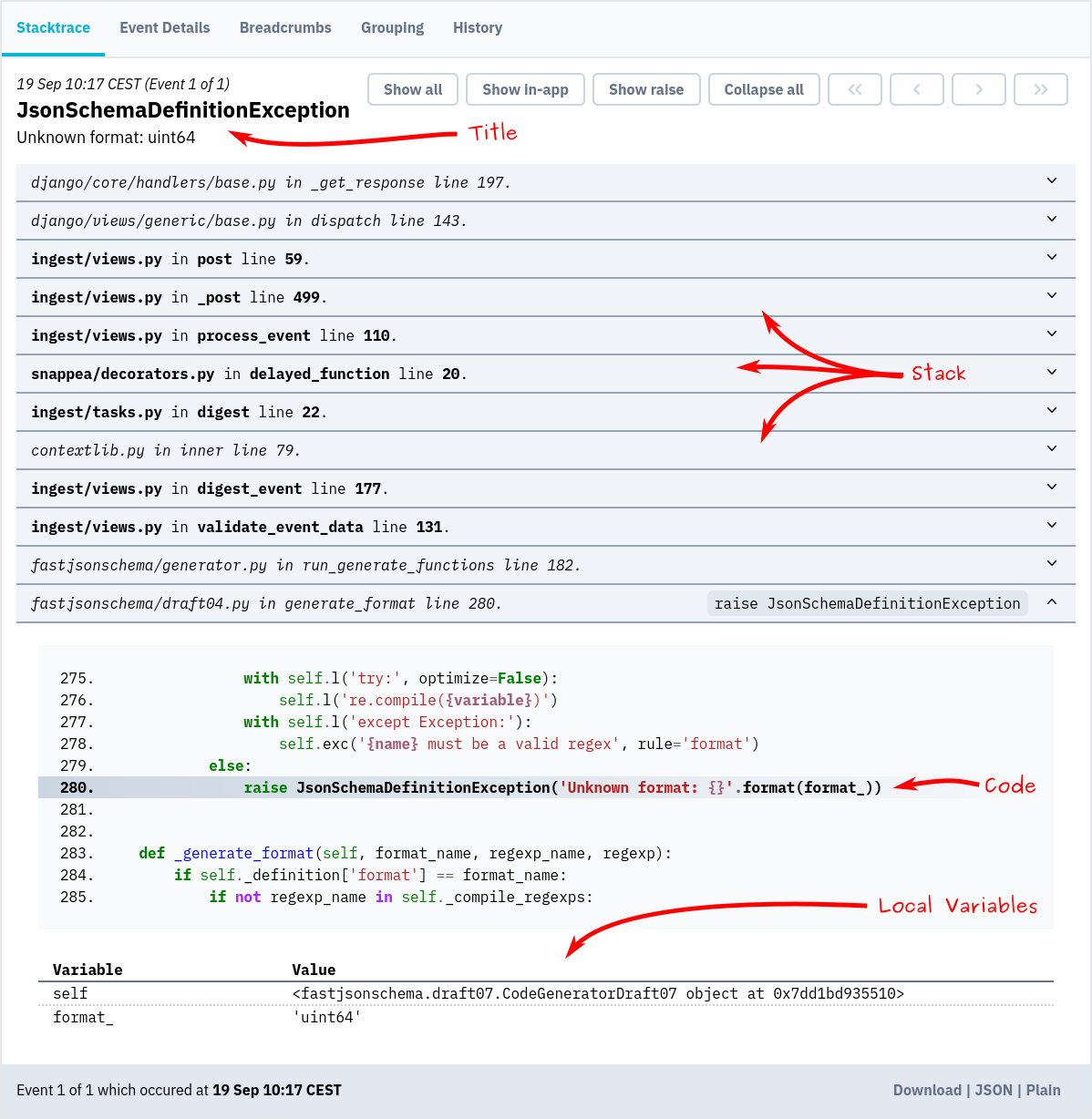
Screenshot
This is what you'll get:
Installation & docs
The quickest way to evaluate Bugsink is to spin up a throw-away instance using Docker:
docker pull bugsink/bugsink:latest

docker run \
  -e SECRET_KEY={{ random_secret }} \
  -e CREATE_SUPERUSER=admin:admin \
  -e PORT=8000 \
  -p 8000:8000 \
  bugsink/bugsink
Visit http://localhost:8000/, where you'll see a login screen. The default username and password
are admin.
Now, you can set up your first project and start tracking errors.
Detailed installation instructions are on the Bugsink website.