mirror of
https://github.com/jlengrand/bugsink.git
synced 2026-03-10 08:01:17 +00:00
 1b5cf8dea4
Bugsink 2.0 upgraded to Django 5.2 (from 4.2) under the hood. However, Django
5.0 made it so that on MariaDB >= 10.7, UUIDFields are stored as native UUID
fields, and special conversion steps are required.

The Django 5.0 release notes suggest basically downgrading your existing UUIDs
to CharField values and sticking with that forever, but that's not a workable
solution for us for many reasons:

* Bugsink is multi-DB-backend, and this change would affect them all. I don't
  want to force postgres-users to downgrade just for this.

* Bugsink 2.0 is already out in the wild, and people who've deployed it on
  MariaDB >= 10.7 would already "be in the correct future" (have UUID columns).
  i.e. the "solution" would just create the inverse problem.

* What with new models with new UUID fields? We'd run the rist of a "mix" with
  all the future complexity that comes with _that_.

So I've decided to just bite the bullet and force an upgrade. The provided
command allows users to upgrade their data. Just run:

```
bugsink-manage convert_mariadb_uuids
```

I have not (yet) provided this as a migration (it's always an option for the
future)... mostly for lack of time but also because we "need this as a command
anyway"... because people that would be on MariaDB < 10.7 still need this
tool whenever they migrate to >= 10.7.

Fix #226
Bugsink: Self-hosted Error Tracking
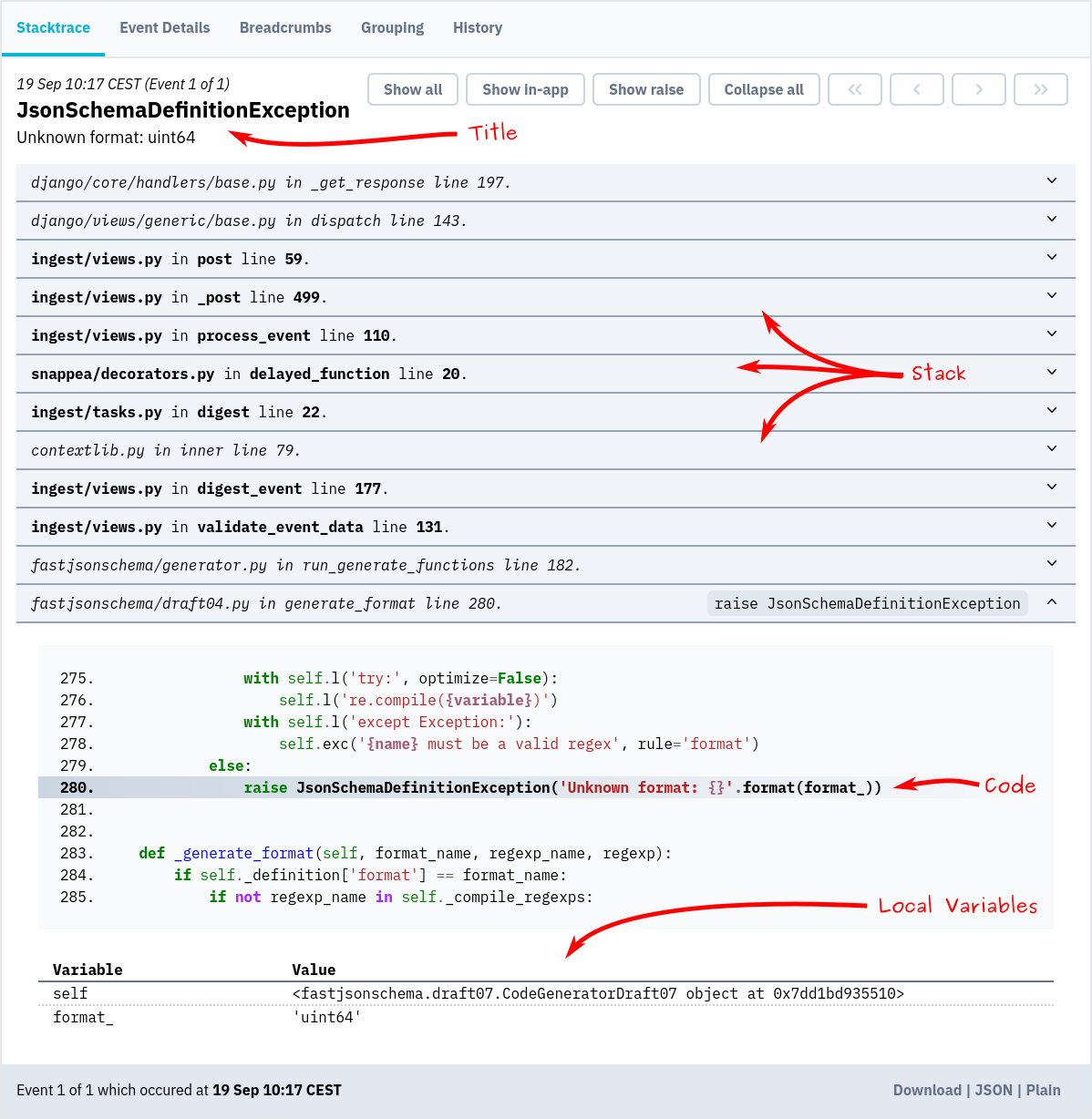
Screenshot
Installation & docs
The quickest way to evaluate Bugsink is to spin up a throw-away instance using Docker:
docker pull bugsink/bugsink:latest

docker run \
  -e SECRET_KEY=PUT_AN_ACTUAL_RANDOM_SECRET_HERE_OF_AT_LEAST_50_CHARS \
  -e CREATE_SUPERUSER=admin:admin \
  -e PORT=8000 \
  -p 8000:8000 \
  bugsink/bugsink
Visit http://localhost:8000/, where you'll see a login screen. The default username and password
are admin.
Now, you can set up your first project and start tracking errors.
Detailed installation instructions are on the Bugsink website.